

What local SEO is, plainly
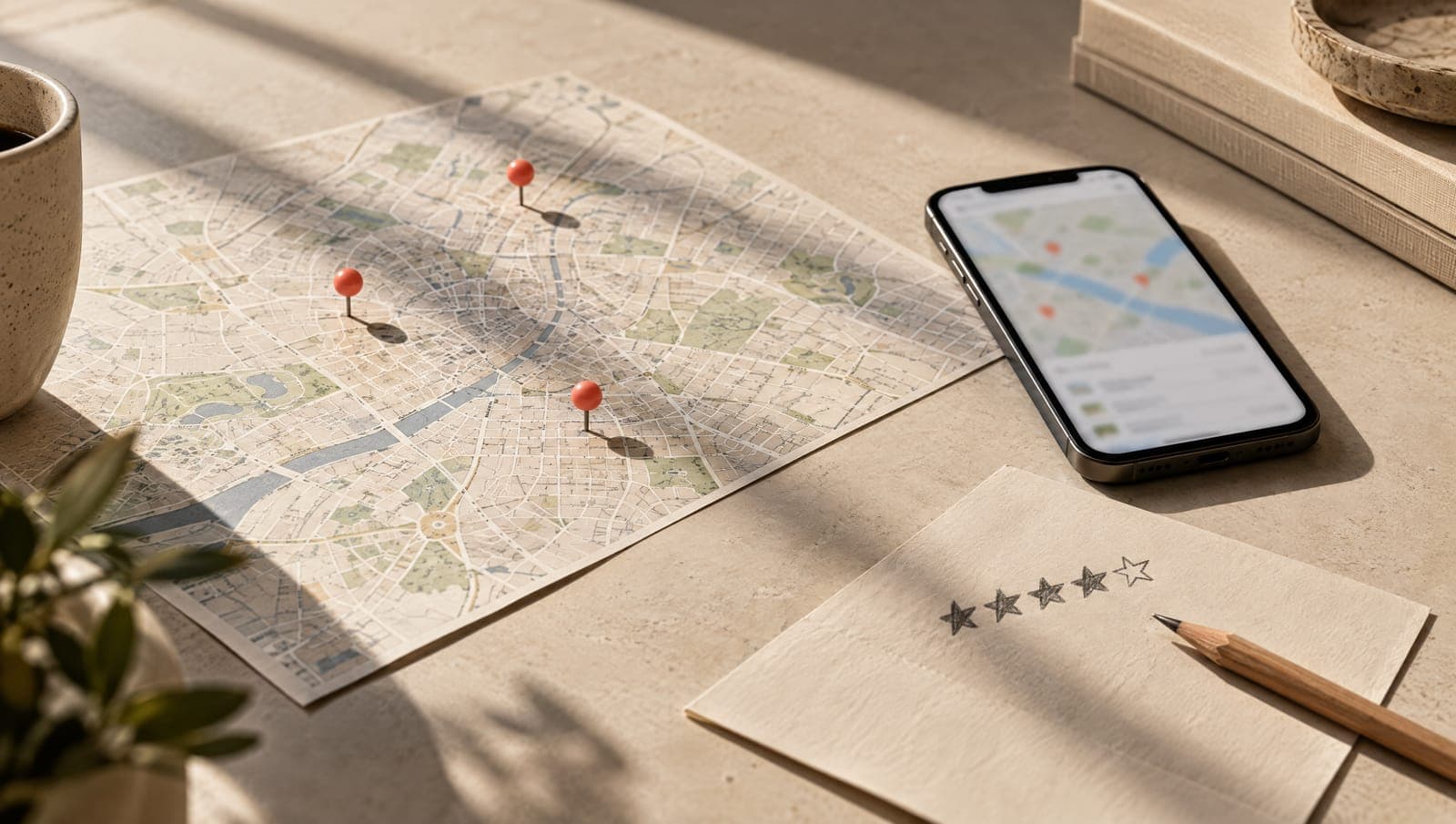
Local SEO is the work that gets a business to appear when someone searches for what it sells near where they are. “Dentist”, “restaurant for groups”, “sofa repairs”: Google understands that those searches are made with the intention of going, calling or booking, and answers with a map and three listings before it answers with web pages. That block, the local pack, is where most of the calls to a business with a door get decided.
What it isn't: writing “in Sabadell” at the end of every sentence, creating a page for every town in the area or paying someone to register you in directories nobody reads. That was what people did ten years ago and today it takes away more than it adds.
Why the profile counts for more than the website
We see it with our local clients, whether it's a restaurant, a dental clinic or a furniture shop with a warehouse: the Google Business Profile brings in more direct enquiries than the website. It makes sense. Somebody looking for a dentist at seven on a Tuesday evening doesn't want to read a page about treatments; they want to see where it is, what its rating is, whether it opens tomorrow and a button to call. The profile gives all of it on one screen.
The website still matters, but at a different moment: when that person compares two clinics, wants to know who will be treating them or is looking for a specific treatment. That's why at Digency we treat the profile as one more page of the website, with the same care as the home page, and not as a form you fill in once and forget.
What decides who appears on the map
Google explains its criteria in three words: relevance, distance and prominence. Translated:
- Relevance: your profile saying clearly what you do. The right primary category, secondary categories that genuinely apply, services filled in with the names people use.
- Distance: where the person searching is in relation to you. You can't control it, short of opening another site. Accepting that saves a lot of money on tricks.
- Prominence: how much you're talked about outside your profile. Reviews, mentions in the local press, real directories, links from your association's website or from your suppliers'.
Of the three, you can only work on two. And the first is sorted in an afternoon if it's done with judgement.
The profile, field by field
Nearly every profile we audit has the same gaps. What we go through, in order:
- Primary category. It's the field that counts for most. “Dental clinic” and “Dentist” don't rank the same; you have to pick the one used by the searches with most volume in your area, and that gets looked up, not assumed.
- Name. The real name of the business. Adding keywords to the name (“Sonrisas Dental Clinic Implants Sabadell”) goes against the rules and can be reported. Competitors of yours do it; they can be reported too.
- Services and products. One per line, with the name a customer would use. It's where Google reads what your business is about when the category isn't enough.
- Photos of your own. Of the premises, the team, the product. No stock images. Photos with real people get more clicks and, on top of that, Google spots the catalogue ones.
- Real opening hours, bank holidays included. A profile that says “open” on a day you're closed earns you a one-star review with a name attached.
- A description with what you do and who for, with no promises.
- Posts now and then, with no template, no fixed time and not the same photo going round. Google flags content that looks automated as automated, and a flagged profile loses visibility.
Reviews: what they're for besides the rating
Reviews do two visible things: raise the rating and build trust. And a third almost nobody uses: they tell you what your customers call your service. In reviews people write “they fixed my sofa at home” or “they took away my fear of the dentist”, not “on-site upholstery” or “conservative dentistry”. Those phrases are real searches, in their words, and they're worth using on the profile, on the website and in the ads.
How to ask for them without it looking like a campaign: the moment the customer is happy, with the direct link to hand, and one at a time. A sign on the counter works less well than a sentence from the person who served them. And answer all of them, the good ones too: Google values it and, above all, the next customer reads it.
Negative reviews don't get deleted, they get answered. Calmly, with facts and with an invitation to talk in private. One composed reply to a complaint convinces more than twenty five-star reviews with no text.
Contact details: the same comma everywhere
Name, address and phone number have to be identical on the profile, on the website, in the footer of every page, on your association's page and in any directory you appear in. Identical: “Via de Massagué, 26” is not the same as “C/ Massagué 26” to a machine. Every difference is a doubt, and doubts are paid for in visibility.
Before creating anything new, we look for the profiles and listings that already exist, sometimes set up by former employees, by automatic directories or by a well-meaning supplier. They get claimed, corrected or removed. It's boring work and it's the work most needed.
The website: one page per service, not one per town
This is where most money has been thrown away in the last decade. Creating “dentist in Sabadell”, “dentist in Terrassa” and “dentist in Barberà” with the same text and a different town name hasn't fooled anyone for years. Google treats them as duplicates, and all they achieve is competing with each other and with your home page. We see websites with dozens of city pages that get thousands of impressions from crawlers and not one click from a person.
What does work is one page per service, written for the person searching for it, with the town named where it makes sense to name it, the address in the footer and local business structured data confirming to Google the same thing the profile says. If you genuinely have several sites, then yes: one page per site, with its own profile, its hours and its team. It's what we do in SEO, and when the website doesn't allow it, it's the first reason to redesign it without losing what already performs.
What to measure and what not to
What matters fits into four figures from the profile: calls, route requests, clicks to the website and messages. You can see them in the profile's dashboard and compare them month by month. “Views” and impressions are useful as context, but they don't pay wages.
Two honest warnings. One: the profile's figures move about a lot from one week to the next without you having done anything; you judge the trend over several months, not the jump from one day. Two: some tool reports still show metrics Google retired that always return zero. A perfect zero for weeks on end is hardly ever your business: it's the tool.
Where to start this week
If you only have one afternoon: check the primary category, upload ten photos you've taken yourself, fill in the services with your customers' words and answer the outstanding reviews. If you have a month, add the directory sweep and one page per service on the website. And if you want us to do it, we start by looking at your profile and your website and telling you, with data from your area, what moves the needle and what doesn't. When the organic side takes its time, a local Google Ads campaign covers the gap in the meantime, but that's another conversation.