
The problem isn't the ideas, it's the logistics
Almost every guide on social media content creation starts with the types of content: educational, entertaining, behind the scenes, testimonials. It's worth knowing, but it isn't what goes wrong in a company. What goes wrong is that something has to go out on Monday, nobody has filmed anything, the manager's phone has three blurry photos and what ends up published is a stock image with a line of text on top.
At Digency we handle social media management for restaurants, clinics, shops and factories, and the only way we've found to get good content out every week is this: one shoot a month, on site, with a shot list, that produces material for thirty days. This article is about how that morning works.
What to film: five things every business has
Before thinking about formats, you have to know what material exists. Any company, whether it's a bar or a machining workshop, has these five sources:
- The process. How what you sell gets made. The dough being stretched, the machine cutting, the dentist explaining an X-ray. It's what people never see and what they watch most.
- The people. Whoever serves, whoever makes, whoever cooks. The faces and, if they'd rather not appear, the hands.
- The product or the result. The finished dish, the reupholstered sofa, the completed part, the smile after the treatment (with permission, always).
- The place. The bar mid-afternoon, the waiting room, the tidy warehouse. The place says what the company is like without saying it.
- The questions you get asked. What customers ask on the phone or at the counter is a list of videos already written for you. “Do you do gluten-free?”, “How long does an implant take?”, “Do you deliver to site?”.
Those five sources hold material for years. The work is ordering it.
One morning's shot list
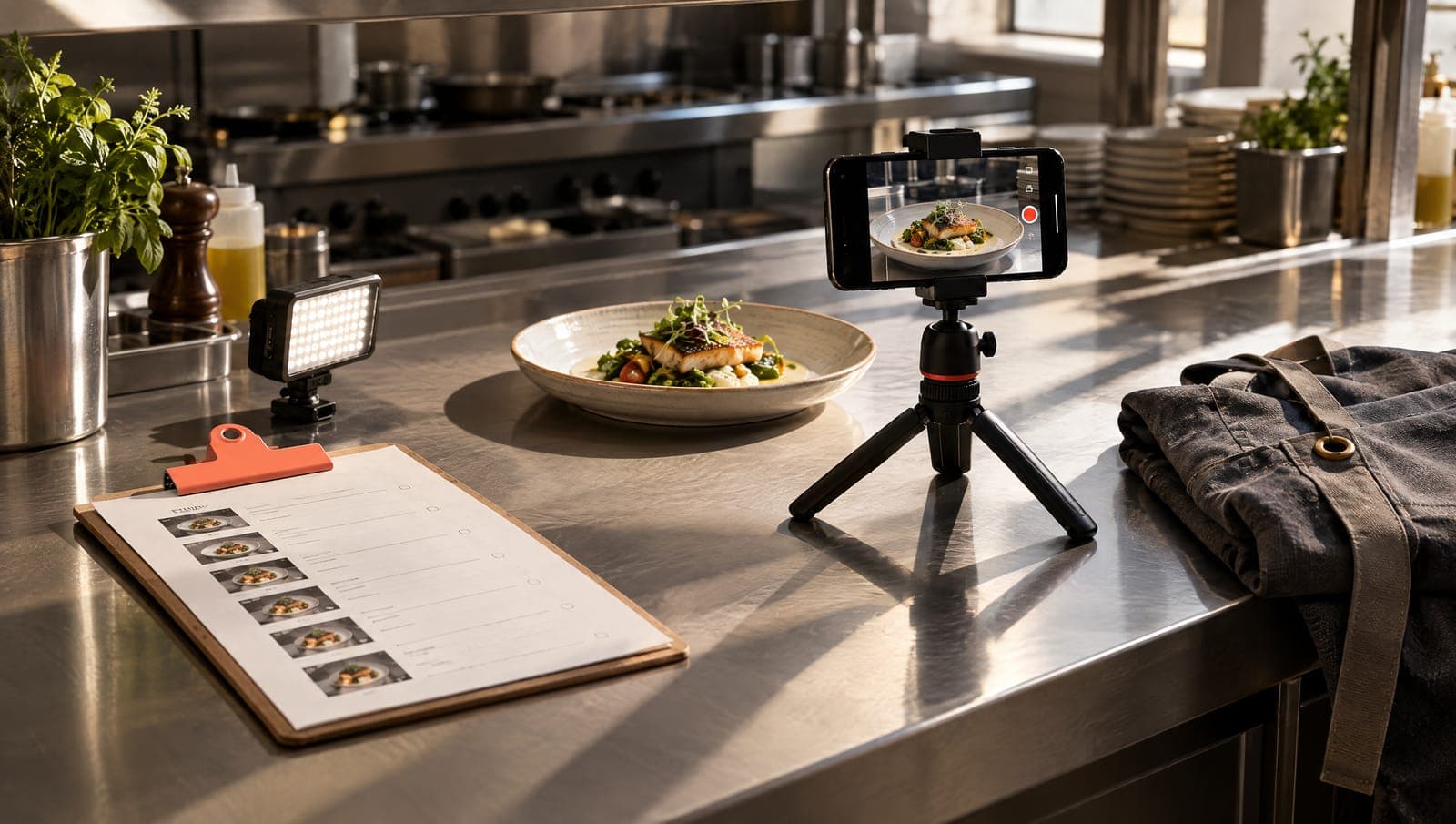
A shoot without a list is a morning wasted. Before going, we write down what we're going to film and in what order, starting with whatever depends on the time of day (the light, the service, the shift) and leaving until last whatever can be repeated. A real example of the structure for a restaurant, three hours:
- First hour, the kitchen before service. Prep: knife work, burners, hands. Short shots, plenty of them, no dialogue. This is where the material for the process videos comes from.
- Second hour, product. Four or five dishes plated up in natural light near the window. A photo and a video of each: the overhead shot, the close-up, the serving gesture. It works for social media, the menu, the website and the Google Business Profile.
- Third hour, people and place. The team in position, the dining room empty and then filling up, the bar. And ten minutes with whoever is willing to talk to camera answering three customer questions.
For a factory the structure is the same with different content: the machine running, the part at different stages, quality control, loading the lorry, the operator explaining in a minute what they do and why it matters. And in a clinic, the process is shown through the team and the explanations, not through the patients.
Who appears: the people inside
There's a temptation in every company: show the product and not the people, because “we're not photogenic”. It's a mistake, and we see it in our clients' figures: pieces with real people from the team, doing their job or explaining something, get watched and saved more than pieces with product alone. On an industrial company's account, the video of the person running the machine performs better than the one of the machine. In a restaurant, the chef explaining a dish beats the dish.
Nobody has to act. Somebody from inside has to tell you something they know, in their own workplace, in a minute. The camera and the edit do the rest. And anyone who'd rather not appear isn't made to: hands, backs and close-ups do the same job.
Formats: which piece for which job
One morning's material doesn't turn into thirty identical pieces. Each format does a different job and gets chosen for that, not for fashion:
- Short vertical video (Instagram, TikTok): so people who don't know you discover you. Process, people, one idea per piece, fifteen or thirty seconds.
- Photo carousel: to explain something properly to people who already follow you. A dish step by step, a before and after, five frequently asked questions.
- Stories: for whatever expires tomorrow. Today's menu, a free slot, the lorry leaving. They don't replace the content on your feed; they go alongside it.
- Longer video (YouTube, LinkedIn): to explain how a machine or a treatment works to somebody comparing suppliers.
- Single photos: for the Google Business Profile, the website and printed material. Every shoot produces these too, and they're often the hardest-working of the lot, because the Google Business Profile shows them to anyone searching nearby.
The rule: one piece, one idea, one job. A video that tries to show the process, introduce the team and announce an offer does none of the three.
What we throw away and why
More than half of a morning's filming gets thrown away, and that's fine. We discard:
- Anything that needs explaining. If you have to read the caption to understand the image, it doesn't work on social media.
- Anything that looks like an advert. Product on a white background with the logo in the corner gets scrolled past. That material goes to the website or the catalogue.
- Anything already seen. The same shot of the same machine as last month. That's why the list changes every month and we note down what was filmed.
- Trends that don't fit. A sound everyone is using can work in a bar and look ridiculous on a machinery manufacturer's account. We use trends when they fit what the company is, not to fill a gap.
- Anything the company doesn't want shown. A customer who hasn't given permission, a confidential process, an untidy corner. We ask beforehand and we respect the answer.
From the morning to the calendar
The shoot ends with the material on a drive and the work carries on at the desk: it gets selected, edited and the text for each piece written. With that the month's calendar is built: what goes out, on what day, on which network and with what purpose. The client sees it before the week starts, approves it or changes it, and only then does it get published.
That review is the part plenty of companies skip when they do it alone, and it's the one that prevents the expensive mistake: publishing something that shouldn't have gone out. A calendar also makes it obvious when there's nothing to say, and in that month less gets published. Publishing for the sake of it shows, and it shows more than not publishing.
When what you need is a campaign
Social media gets you known and gets you trusted. It doesn't fill the place tomorrow. If what's in front of you is a specific date (an opening, a launch, a season starting), organic content isn't enough and it has to be pushed with spend or with a campaign built on its own idea. That's what our advertising and campaigns service is for, and the material from the monthly shoot usually serves as the base, so nothing has to be produced from scratch.
But that comes later. First, a morning with a shot list. That's what turns “we need to publish more” into a month of content that actually belongs to you.